

Cate Lockhart, PharmD, PhD
Chief Science Officer, AMCP
Executive Director, BBCIC
April 3, 2026
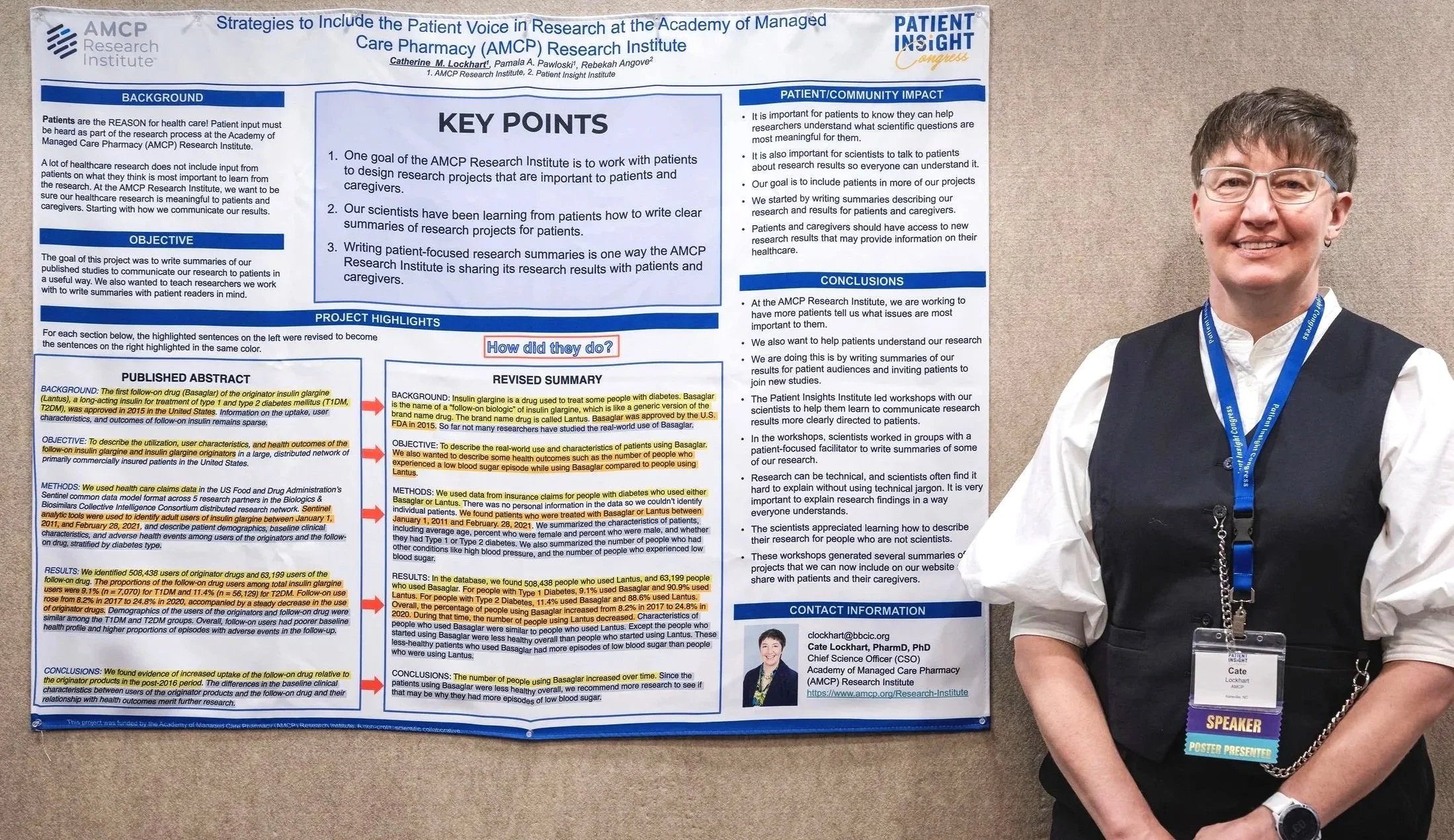
At the Patient Insights Congress 2025, the Academy of Managed Care Pharmacy (AMCP) Research Institute shared two connected projects with a shared goal: make health research and health plan decisions work better for real people. One project focuses on how researchers talk to patients about study results. The other focuses on how health insurers (often called “payers”) can use information from everyday care—called real-world data—to make smarter medication coverage decisions.
1) Bringing the patient voice into research communication
The AMCP Research Institute has a simple idea: patients are the reason health care exists, so research should reflect what patients and caregivers actually care about—and the results should be understandable. The team partnered with the Patient Insight Institute to run workshops that helped scientists practice writing clear, patient-focused summaries of research studies. Scientific articles often include technical terms (“jargon”) that can make findings hard to use outside of academia and medical care. By revising research summaries with a patient reader in mind, the Institute aims to share findings in plain language on its website and in other materials, so patients and caregivers can access new evidence that may affect their care. The long-term goal is also broader: involve patients more often when choosing which research questions to study in the first place.
2) Helping payers use real-world data for formulary decisions
Health plans need to decide which medications they will cover and under what conditions. Pharmacists working at insurance companies review clinical trials and other evidence to judge how well a medicine works and whether it is worth the cost. This project highlights why real-world data matters. Clinical trials are essential, but they don’t always capture what happens in routine care—where patients may have other medical conditions, different levels of support, and different patterns of medication use. Real-world data can come from sources like medical charts and patient questionnaires collected during regular doctor or hospital visits. Importantly, the data used for research is de-identified, meaning information that could point to a specific person is removed.
To make real-world evidence easier to use in coverage decisions, the AMCP Research Institute convened experts from pharmaceutical manufacturers and health insurers and reviewed existing guidance. They found that prior checklists were not tailored to U.S. payer decision-making. The group then built AMCP “Real-World Evidence (RWE) Standards”: a framework, 29 final criteria, and practical checklists that clarify (a) what types of real-world studies are useful at different points in a medicine’s lifecycle (before approval, at launch, and after wider use), (b) which outcomes matter (clinical results, safety, how consistently people take the medicine, and costs/health care use), and (c) key questions such as data sources used and study limitations.
Why this matters
Together, these projects point to a more patient-centered system: research that is easier to understand and evidence that better reflects day-to-day reality. When patients can access clear summaries and payers can apply clear standards for real-world evidence, decisions about treatments and coverage have a better chance of matching patients’ lived experiences and priorities.